Deep Listening as a Partnership Practice
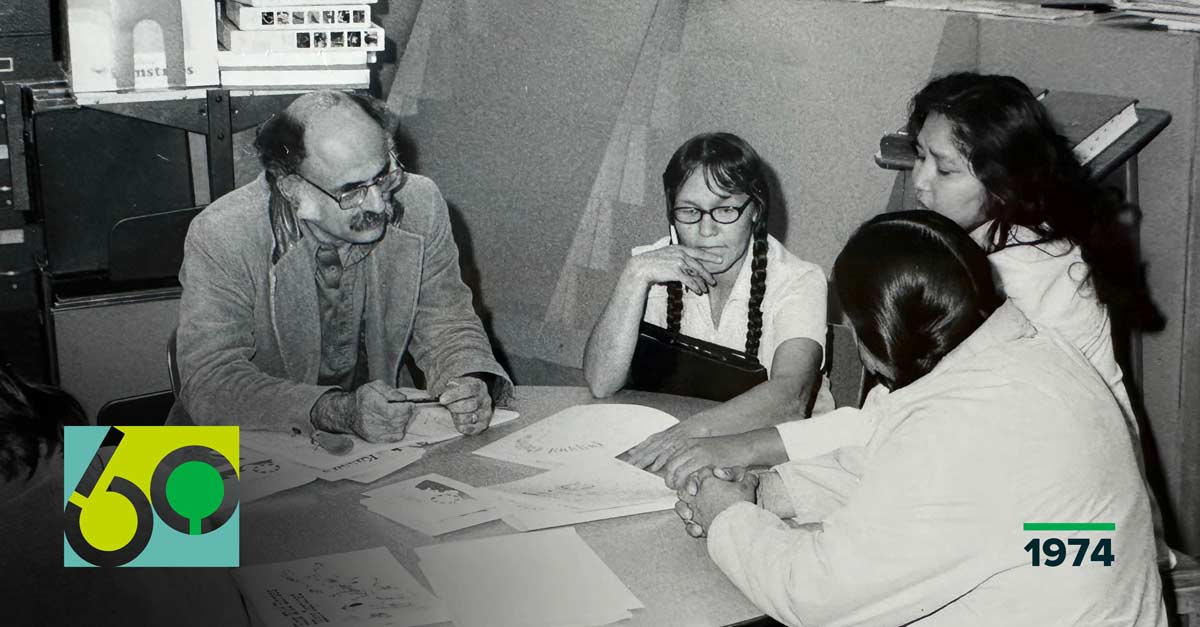
This post is part of Education Northwest’s 60 Years of Partnership series: an exploration of effective partnerships, what they look like in practice, and the possibilities they generate for education systems and communities.
When I was a child, aunties and uncles or family friends would stop by to visit, almost always unannounced, to catch up at the kitchen table over cups of coffee and whatever snack was in the cupboard. As I played down the hall, I listened—not so much to the exact words, but to the emotional context of their interactions. Sometimes it was boisterous and full of laughter, other times somber and serious. Most often they simply talked and listened to each other about their day or job or family. Observing this type of coming together among those I loved made me feel connected and safe.
Over time I have come to understand more profoundly that my community and many other Indigenous peoples place a high value on the skills of listening and observation. These foundational skills emphasize sensory engagement and community connections very early on. They help us to make sense of the world around us, to learn from experts, observe collaboration in action, and develop community-centered orientation. These skills are also about care, respect, and understanding of the people around us and the natural world—waterways, land, animals, plants, and the seasons. They are essential to being a good relative, finding balance, and sustaining the health and well-being of the whole ecosystem.
In our work, I strive alongside my team to establish listening as a core practice of our partnerships: with Tribes, districts, states, and other organizations. Effective partnerships depend on paying close attention to context, perspectives, and the stories of others. We need to deeply understand modern ecosystems—the community relationships, values, strengths, and challenges—before we can co-create something meaningful.
We need to deeply understand modern ecosystems—the community relationships, values, strengths, and challenges—before we can co-create something meaningful.
Understand How Historical Context Shapes Today’s Partnerships
Throughout history, the voices of different cultural, ethnic, and racial groups were diminished or ignored. Literal silencing through refusal to listen. Outsiders deliberately came in to dictate how things should be, with little to no understanding of the people, places, cultures, and ways of being that they were destroying. This was a calculated strategy used to conquer and control.
Academia and the field of research took another approach that has made many Indigenous communities extremely wary of outside partnerships, and rightly so. Native peoples have had outsiders come in and sit in our communities, eat at our tables, join our community events or ceremonies—a study of our lives, languages, and histories. Their observations have been primarily self-serving, with little return to the community, and often occurred without explicit consent or transparency about their ultimate objectives.
Both contexts inform how Indigenous Tribes and communities approach working with potential outside partners today. Native people are wary and suspicious when people come in and say, “We have a solution,” or “We want to help you.” Indigenous nations and local communities now hold absolute authority over engagement frameworks. They dictate the rules of partnership, resource sharing, data and legal agreements, and so much more. This shift rejects historical top-down systems and builds a model rooted in genuine self-determination and Tribal sovereignty. It also relies heavily on building relationships and being willing to work at the speed of trust.
Indigenous nations and local communities now hold absolute authority over engagement frameworks. ... This shift rejects historical top-down systems and builds a model rooted in genuine self-determination and Tribal sovereignty.
Pay Attention to the Community’s Unique Story
It is important to recognize that every community has its own unique story. Native cultures are deeply nuanced, not monolithic. For too long, educational materials, especially history books, intentionally flattened American Indian experiences into a single identity. In truth, Indian communities are incredibly diverse, forming a beautiful and complex tapestry of different cultures.
Being aware of that diversity is crucial, even for Native consultants like me and my colleague, RunningHorse Livingston. When our Native education team was invited to work with a Tribe in Western Washington, we knew that the first step was doing our own work to learn more about the Tribe’s government, current affairs, and historical and political realities. We completed all our background preparation before our first big meeting with the Tribe.
When we finally sat down with their community members, elders, leaders, advocates, and educators, we made sure to step back and listen. The Tribe shared their direct needs and goals with us. They also questioned us thoroughly about our background, organizational values, and expertise to ensure our collaborative approach properly aligned with their vision for a new Tribal curriculum and training program.
Listen to Learn, Not to Satisfy Your Agenda
In initial partnership meetings, thorough introductions are really important. Introductions on both sides—our team and our partners—allow us to build trust and understand one another. During introductions, our team has a chance to share part of our story and why the work is meaningful to us, and our partners and their invited community members have time to talk about their experiences and goals … and we do not limit that time.
Introductions can take longer than you think, but you never interrupt someone. If they tell a story about themselves or their family, or describe something from their past or their experience, there's a point. You might not immediately think it fits the context, but it almost always does. You need to receive it, hold space for it, and remember it. Down the road, you will realize why that individual chose to share what they did. You begin to understand the significance as the work unfolds.
You need to receive it, hold space for it, and remember it. … You begin to understand the significance as the work unfolds.
When we build educational materials for a Tribe, we listen closely as community members share the essential experience and knowledge that they want teachers to teach and students to learn about them. And people in the room often build on what is shared by others. We don’t interrupt them and say, “Well, now the agenda says we have to move on,” or “Sorry, everybody already spoke once.” Those rules don't exist. You have to let people make connections and transitions that come naturally. Hearing each other, new things can come. Old things come to mind. And our role is to listen actively so that people can see that we are engaged and receiving their words.
Follow the Community’s Lead
In a true partnership, you follow the community’s lead—at their pace. That means taking as much time as needed for introductions and subsequent times together and letting the community shape the conversation. It also means respecting what the community does and does not want to share.
I previously highlighted the incredible diversity across Indian Country and the not-so-distant history of outsiders embedding themselves in our communities to study us, only to exploit that knowledge for their own ends. When partnering with communities, especially Tribes, you need to respect what they want to share or make publicly available. The level of Tribal specificity they are willing to provide will influence the depth and the aperture of what you build together.
Own Mistakes and Make Amends
There's no way that you can take your experience, your lens, your perspective, and get working with another community right all the time. You just can't.
At times, our team has misrepresented something that we thought we were listening to keenly. The kind of work we do—building Tribal curricula or consulting with communities—we take in a massive amount of information. And even when we listen well, there are multiple perspectives, varying narratives, and differing opinions. We try to land on something that feels right and authentic, and sometimes we get it wrong. But this work ties directly to people's lives and experiences, and nobody wants to be misrepresented. That's a terrible feeling.
In those moments, we are ready to make amends. My colleague RunningHorse likes to call this “embracing error.” When a mistake happens, own it immediately with the individual or group. Skip the excuses, keep the focus off yourself, and address the issue head-on. Just say, “We got this wrong; we hear you, and we’re going to fix it.” In my experience, validating the problem, apologizing sincerely, and offering a solution is the only effective way forward.
Prioritize Local Strengths and Values
Throughout education, leaders and organizations often build tools or frameworks that can be useful, but they push them as universal models for every school. Instead of advancing a one-size-fits-all approach, these models must be adapted to meet unique local needs. There's no way to do this without spending time in their community to listen and observe.
There are practices that work across communities and schools, but if you don't adapt them by combining them with what you know and have observed about specific students, educators, or the community … you're missing a huge piece of the puzzle. You take away the opportunity for the people that live and work and learn there to have any ownership, because you did not listen to them first.
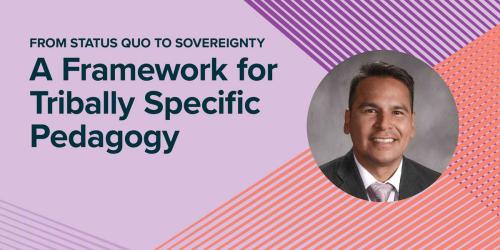
Over the past few years, my colleague RunningHorse has been refining our Framework for Tribally Specific Pedagogy as a process to support educational sovereignty: Tribes taking control of the education of their youth using their specific ways of teaching and learning. From start to finish, the entire process is embedded in listening closely: first to Tribal elders as they articulate their values and their pedagogy, and later to educators who build strategies to weave those elements into their instruction. Our team then supports the Tribe and local education systems to implement the Tribally specific practices.
The end result is a culturally specific educational process that benefits Native students and communities, as well as the educators who support them. Through deep listening and observation, we foster an ecosystem where everyone can grow and flourish.
Mandy Smoker Broaddus has over 20 years of experience working toward social justice, equity, inclusivity and cultural responsiveness, particularly in the realm of American Indian education. She has served at the tribal college, K–12 and state education agency levels across her home state of Montana, where she is a citizen of the Assiniboine and Sioux tribes of the Fort Peck reservation.