
Apprenticeship in the United States: Understanding the Landscape

What comes to mind when you hear “apprenticeship”? A medieval cobbler or blacksmith? For many, that’s still the image—but today’s apprenticeships look very different. Modern apprenticeships are dynamic career pathways into high-demand, well-paying jobs across industries like health care, advanced manufacturing, technology, and more. They are for everyone, including young people, career changers, and those seeking to grow their skills. This new picture of apprenticeships opens doors to economic mobility and lifelong career success.
While apprenticeships have historically been less common in the United States, changing workforce needs, rising college costs, and a growing focus on career readiness are bringing them back into the spotlight. Federal and state initiatives are prioritizing apprenticeships to support economic growth, but making the most of this moment requires coordinated action from employers, unions, educators, government, and community organizations.
This resource provides an overview of apprenticeships: what they are, who participates, what the benefits are, and strategies to expand them. It offers a foundation for anyone looking to better understand and support apprenticeship pathways.
What Are Apprenticeships?
Apprenticeships combine on-the-job training with classroom learning. Apprentices work alongside skilled mentors, gaining hands-on experience while earning a wage that increases progressively. In addition, they receive related supplemental instruction in a classroom setting. At the end of the program, apprentices earn a certificate of completion, giving them the skills and recognition to advance—or “journey”—in their chosen career. By combining learning with earning, apprenticeships provide individuals with direct access to meaningful work while helping employers develop a skilled workforce.
By combining learning with earning, apprenticeships provide individuals with direct access to meaningful work while helping employers develop a skilled workforce.
Apprenticeships have existed in the United States since its founding and were formally recognized by the federal government through the National Apprenticeship Act of 1937. This law put the U.S. Department of Labor in charge of apprenticeship programs, allowing states to register and oversee programs in partnership with the Department (Office of Apprenticeship, or OA, states) or establish their own state apprenticeship agencies (SAA states).
There are several types of apprenticeship programs. Registered apprenticeship programs are officially recognized by the Department of Labor or state agencies and follow national standards to ensure quality and consistency. They typically last three to five years and combine more than 2,000 hours of on-the-job training with about 144 hours of related supplemental instruction per year. On-the-job training is paid by—and usually happens directly with—the employer. Classroom instruction is arranged by the employer and can include college courses, independent providers, or in-house training.
Sponsors design, fund, and support apprenticeship programs. They can be employers, unions, joint labor-management groups, community colleges, or other institutions. Sponsors set program standards, coordinate on-the-job and classroom training, and ensure apprentices meet required competencies. Their involvement is critical to the quality and success of registered apprenticeship programs. Apprenticeship intermediaries are third-party organizations, such as industry associations, community colleges, workforce boards, community-based organizations, or joint labor-management organizations, that support sponsors with program design, recruitment, and connecting apprentices to additional resources.
Other Types of Apprenticeship Programs
- Industry-recognized apprenticeship programs. Operate outside federal registration but meet standards set by third-party entities
- Pre-apprenticeships. Short programs that prepare people for full apprenticeships
- Youth apprenticeships. Designed for high school students, blending academic courses with work experience
In recent years, apprenticeships have emerged as a federal and state strategy to expand individual opportunity and promote economic growth. With growing concerns over college affordability, the need for workforce-ready skills, and changing demands in emerging industries, state policymakers have begun looking to registered apprenticeship programs to connect a skilled workforce with high-quality, in-demand jobs. Apprenticeships have traditionally been concentrated in construction and building trades, but industries such as education, public administration, health care, energy, and finance are increasingly adopting the model to help workers develop new skills and meet evolving workforce demands.
Who Participates in Apprenticeships?
The data in this section come from the Registered Apprenticeship Partners Information Database System (RAPIDS), a federal system that manages data from all registered apprenticeship programs.
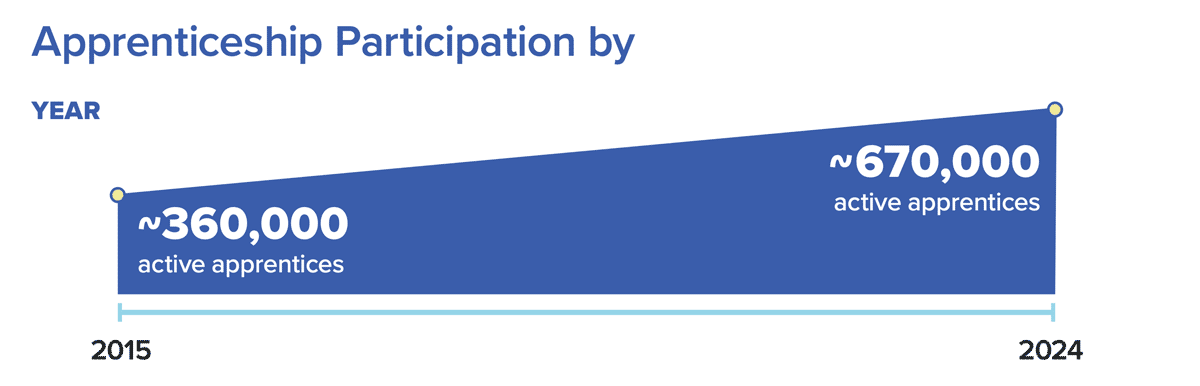
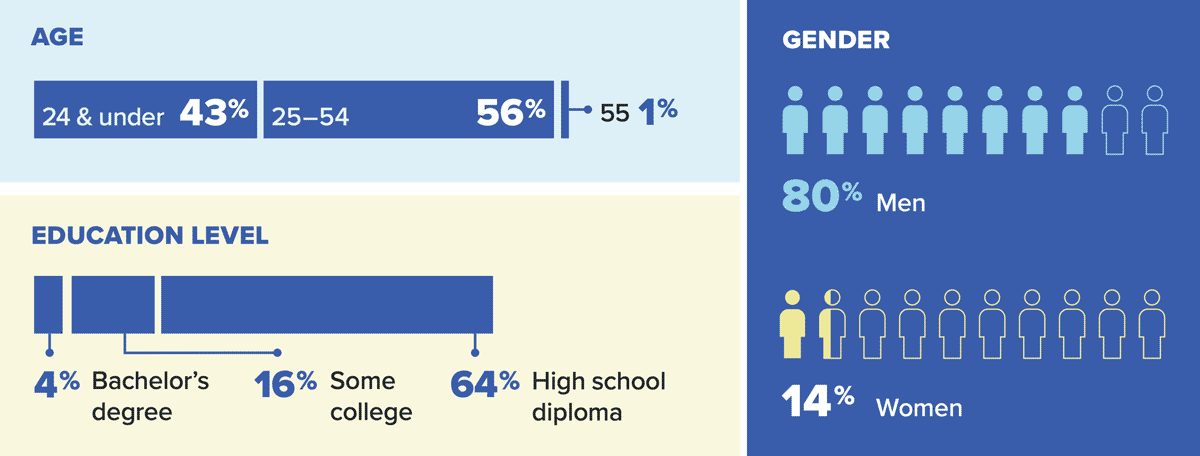
Participation in U.S. registered apprenticeship programs has grown dramatically—from roughly 360,000 active apprentices in 2015 to 670,000 in 2024. Most apprentices are ages 25 to 54 (around 55%) followed by ages 18 to 24 (around 44%). The majority have a high school diploma as their highest level of education (64%). Sixteen percent have some college experience, and 4 percent have a bachelor’s degree.
Participation in apprenticeship varies by population and industry. Women comprise only 14 percent of apprentices. While this represents a 5 percentage-point increase since 2015, women remain significantly underrepresented. Further, women apprentices are concentrated in public administration and health care, with lower participation in higher-wage fields like construction.
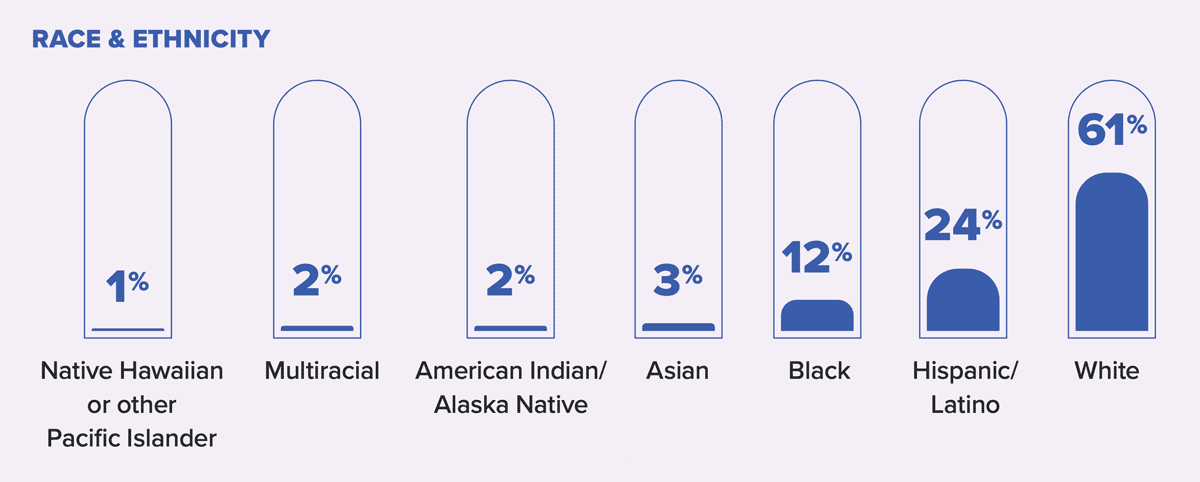
Racially and ethnically, the registered apprenticeship population largely mirrors the general population, except for Hispanic/Latino apprentices, who make up a higher share and are the only group to show significant growth over the past decade. Participation also varies by industry. For example, Black apprentices are underrepresented in construction and education compared to white and Hispanic apprentices, while Hispanic apprentices are underrepresented in construction compared to white apprentices and are more likely to be in education.
Compared to other countries, apprenticeships remain a relatively small part of the U.S. education and workforce system. Other countries, such as Switzerland and Germany, have built robust dual vocational education training models that reach a much larger share of learners. For example, more than half of German young people participate in apprenticeships, compared to just 2 percent of American young adults. These international models are often cited as examples for expanding and strengthening the U.S. apprenticeship system.
There are some limitations to the data on apprenticeship participation. RAPIDS does not currently track pre-apprenticeships, youth apprenticeships, or unregistered apprenticeships, which limits our understanding of who participates and how these programs are growing. There are also instances of missing data on apprentices’ demographics, particularly race/ethnicity, with nearly 20 percent not self-identifying. RAPIDS also provides limited information on apprentices’ experiences—data that are important for assessing retention and outcomes. Additionally, RAPIDS data are not fully integrated with other education or workforce systems, making it difficult to see the full picture of apprenticeship pathways.
Benefits and Challenges to Expanding Apprenticeships
Evidence shows that apprenticeships deliver tangible economic benefits for individuals, employers, and communities.
-

Registered apprentices earn strong starting salaries— around $80,000 on average— and 90 percent remain employed after completing their programs.
-

Employers gain skilled, job-ready workers while reducing turnover and training costs, helping them build a stable and capable workforce.
-

Communities benefit from local economic growth, as apprenticeships contribute to a better-trained workforce and strengthen key industries.
At the same time, there are significant challenges to expanding apprenticeships in the United States:
Employers, unions, and other program sponsors often face limited capacity, funding constraints, and complex administrative requirements. Many also lack clear information on program benefits, costs, and support, making it difficult to decide whether and how to launch new programs.
Many potential apprentices are unaware of apprenticeship opportunities or face challenges accessing them. Once they enroll, apprentices face financial pressures, workplace conditions, and insufficient supports that contribute to low completion rates—particularly for women, justice-involved individuals, and other underrepresented groups.
How to Expand Apprenticeships
Although we have limited research on strategies to expand apprenticeships, lessons from prior Department of Labor grants and state initiatives provide valuable guidance. Successfully expanding apprenticeships requires employer-led, high-quality programs; broad awareness and access to work-based learning opportunities; and a collaborative network of partners supported by policy and funding infrastructure, all guided by data and evidence.
Successfully expanding apprenticeships requires employer-led, high-quality programs; broad awareness and access to work-based learning opportunities; and a collaborative network of partners supported by policy and funding infrastructure, all guided by data and evidence.
Researchers and practitioners have identified promising practices for growing, supporting, and scaling effective apprenticeship programs.
Grow Programs
Expanding apprenticeships involves engaging employers to design high-quality programs that meet local labor market demand, while using multiple pre-apprenticeship and youth apprenticeship programs as entry points into registered apprenticeships.

Prioritize employer engagement
Employers and industries play the leading role in developing apprenticeship program standards; defining skills and competencies; and ensuring apprentices gain hands-on, meaningful experience. Active employer engagement helps ensure apprenticeships provide relevant training, align with industry demands, and attract participants.

Grow in high-demand sectors
While construction and building trades remain a key field, opportunities are growing in health care, IT, advanced manufacturing, AI, finance, and clean energy. Aligning programs with local labor market data on high-demand occupations ensures apprentices develop the skills employers need most.

Expand pre-apprenticeships and youth apprenticeships
Early exposure programs help learners explore careers and build pathways into full apprenticeships. High-quality programs combine clear entry requirements, hands-on experiences, and structured pathways, making apprenticeships more accessible, especially for underrepresented populations.
Support Programs
Once programs are established, expanding access requires raising awareness, connecting apprenticeships to education pathways, and providing comprehensive supports to help people participate.

Promote awareness and positive narratives
Many people are not aware of apprenticeships, assume they are only for certain industries or roles, or see them as less valuable than a college degree. Spreading positive narratives about how apprenticeships change lives and highlighting the wide range of available opportunities helps shift longstanding misconceptions and supports broader participation.

Integrate with education pathways
Apprenticeships are increasingly linked to K–12 career and technical education programs and higher education, which allows participants to earn both educational and apprenticeship credentials. These pathways combine academic and work-based learning, enabling apprentices to earn credit toward their educational and apprenticeship goals. They incorporate credit for prior learning and competency-based models to support the transfer and recognition of skills across systems.

Provide comprehensive support
Apprenticeships are multiyear programs that require extensive hours of on-the-job training and classroom learning. Apprentices and potential participants may face barriers such as transportation, child care, and balancing other work or educational commitments. These challenges can be particularly acute for those in rural areas or from underrepresented populations. Providing supports—such as transportation, child care assistance, and tuition help—can help apprentices persist, complete their programs, and succeed in their careers.
Scale Programs
To expand apprenticeship opportunities for both individuals and employers, a range of partners in the ecosystem can build partnerships, develop supportive policy and funding, and use data and evidence to scale programs nationally.

Build partnerships
Apprenticeships are inherently collaborative: They involve employers, program sponsors, schools, intermediaries, unions, local workforce boards, and government agencies. Strong partnerships help align programs with local needs, create coherent career pathways, and sustain quality over time. Structures like advisory boards, regular stakeholder meetings, and shared goals help maintain these partnerships over time. Intermediaries can also play a key role in connecting partners and facilitating collaboration.

Leverage policy and funding
Supportive policies and sustainable funding are essential to move apprenticeship work forward. Federal and state grants, as well as employer tax incentives, provide initial funding for apprenticeships, but adopting long-term, sustainable funding models, such as pay-for-performance models, can sustain impact beyond short-term grants. Clear policies at the federal and state level can also support the development of high-quality standards and a shared understanding of apprenticeships.

Use data and evidence
Robust data and research on apprenticeship participation, completion, and long-term outcomes is crucial to measure impact and improve programs. Leveraging federal RAPIDS or state-level data can reveal trends over time, and linking apprenticeship data to broader education and workforce outcomes can clarify career trajectories. Evidence on return on investment also helps demonstrate the value of apprenticeships to employers and partners.
The Future of Apprenticeships
Apprenticeships are not just a historical model—they are shaping the future of work.
The most exciting part? We are only beginning to see their potential. As more programs develop and scale, and as evidence grows, apprenticeships could transform how Americans learn, work, and advance in their careers—creating opportunities that last for individuals, industries, and communities alike.