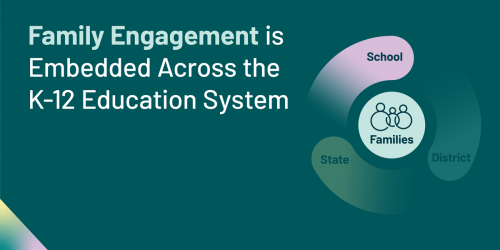
An Introduction to Systemic Family Engagement
Families are essential partners in student learning and success. Yet too often, family engagement is treated as a set of activities—family nights, conferences, newsletters, or volunteer opportunities—rather than a strategy woven throughout an education system.
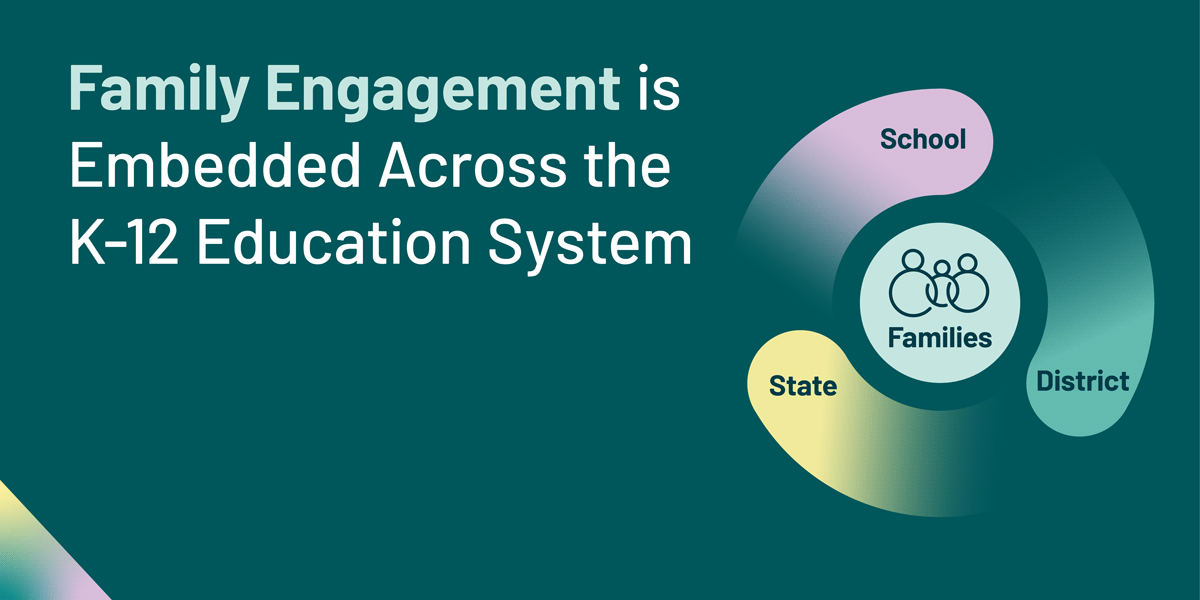
Systemic family engagement expands our lens from isolated activities to focus on how family engagement principles are embedded within the overarching structures, norms, and everyday practices of schools and districts. Family engagement becomes not a thing to do, but a way to work—and an expectation for everyone. When schools, districts, and state agencies each take responsibility for family engagement, families have more consistent and meaningful opportunities to contribute to their students’ learning and to make decisions that shape students’ educational experiences.
Family engagement becomes not a thing to do, but a way to work.
This blog post, the first in a new series, takes a bird’s-eye view of systemic family engagement. It explores how different levels of the education system—schools, districts, and states—can set the conditions to create authentic partnerships with families.
Family-School Partnership Is a Two-Way Relationship
At the school level, systemic family engagement comes to life through everyday interactions between educators, students, and families. Schools can build trusting relationships, create opportunities for two-way communication, connect engagement to student learning and well-being, and invite families into meaningful decision-making. This means moving beyond simply asking whether families attended an event. Authentic two-way relationships require schools to consider whether families feel welcomed, understand how to support their child, have opportunities to share their knowledge and perspectives, and see themselves as genuine partners in the school community.
To be clear, families can choose to engage with their school community in a variety of ways. The goal is not to get every single family to join a committee, but rather to ensure all families have a menu of accessible ways to engage based on their interest and capacity.
Creating Family Engagement Infrastructure at the District Level
Schools cannot—and should not—do this work alone. Districts play a critical role in creating the infrastructure that allows strong family engagement practices to take root across schools.
District leaders can establish a shared vision, invest in staff capacity, provide tools and professional learning, strengthen coordination across departments, and use family perspectives to inform continuous improvement. This helps move family engagement from the work of a few committed individuals to a consistent way of working across the district. It also ensures the presence of the essential organizational conditions outlined in Mapp and Bergman’s Dual Capacity-Building Framework for Family-School Partnerships: that family engagement is systemic (i.e., embraced by leadership across the district), integrated (i.e., embedded in all strategies), and sustained (i.e., with resources and infrastructure).
States Create Opportunity and Accountability
At the state level, leaders have an opportunity to create the broader conditions that make systemic family engagement possible. State agencies can embed family engagement into policies, funding, accountability, school improvement efforts, and statewide initiatives while creating meaningful mechanisms for families to inform decisions.
Alignment across these three levels matters: State policies establish expectations and resources, districts translate those expectations into coherent systems, and schools build the relationships and practices through which families experience partnership directly.
Alignment across these three levels matters: State policies establish expectations and resources, districts translate those expectations into coherent systems, and schools build the relationships and practices through which families experience partnership directly.
Looking Ahead: What’s Next in This Series
In the rest of this blog series, we will explore what systemic family engagement looks like in practice—from schools to districts to state education systems. Drawing on specific projects and lessons from our work, we will highlight practical strategies, tools, and examples that demonstrate how education systems can move beyond isolated family engagement activities toward a more coordinated approach.
Across the series, we will return to a central question: What changes when we treat family engagement not as something schools do for families, but as a way education systems work with families?
Ashley Sheppard is a principal consultant with extensive experience in family engagement and community schools. Before joining Education Northwest, Ashley developed and sustained school-family-community partnerships as a connected schools manager in Washington, D.C. She is passionate about supporting leaders to create the conditions for authentic and effective partnerships between educators and families.