Beyond Individual Schools: Cultivating the District Conditions for Systemic Family Engagement
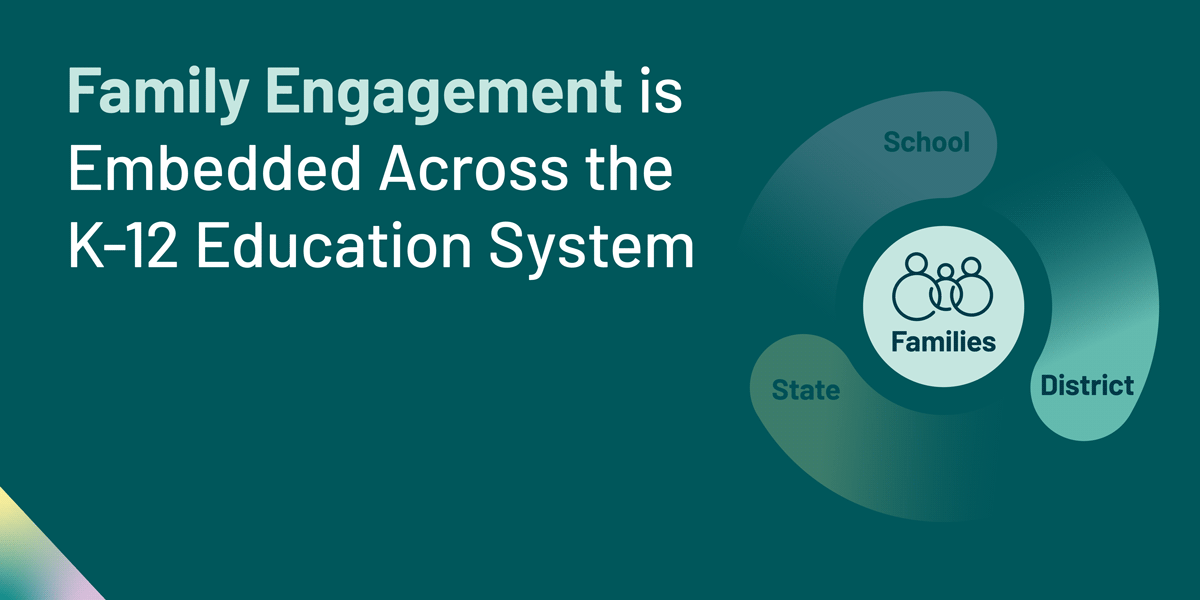
This blog post is the second in a series that looks at family engagement at the school, district, and state levels.
Family engagement takes shape in everyday interactions between families and school staff members: a phone call home, a chat at drop-off, or a meeting to support student learning. But these interactions do not happen in isolation: School districts play a critical role in making two-way family engagement foundational to how schools work.
When districts establish shared responsibilities, coordinate efforts across departments, invest in staff capacity, and center family perspectives in decision-making, they create conditions for schools to build and sustain stronger family-school partnerships. This is the central idea behind systemic family engagement: meaningful, two-way partnerships with families embedded in the structure, norms, and everyday practices of an education system.
Systemic Family Engagement Starts With a Mindset Shift
A systems lens challenges familiar assumptions about what family engagement looks like, who is responsible for it, and how it supports learning.
Family engagement happens every day, in every building.
Family-school engagement is a shared responsibility. It is not limited to specialists, programs, or one-time events; it grows through everyday relationships. District leaders reinforce this message by modeling partnership; showing that family perspectives matter; and providing the time, resources, and support schools need to authentically engage families as partners.
Family engagement is essential for school engagement and academic progress; it is not an extra.
Families are not simply recipients of information or participants in school activities; they are informed decision-makers and partners in learning. Their knowledge helps educators support each student. At the district level, this means embedding family engagement in resource allocation, teaching and learning, staff development, and efforts to partner with families over time.
How Districts Can Turn the Mindset Into Practice
Our work as evaluation partners points to four conditions that help districts move from intention to sustained practice. These strategies reflect what districts are already doing, as well as the recommendations and aspirations shared by families, teachers, school leaders, and district staff members in focus groups and surveys. They also align with what we know from implementation science about what it takes to make new practices take hold in organizations and systems.
The Role of Districts in Promoting Systemic Family Engagement

Communicate a shared vision for how family engagement supports your district’s academic goals.
- Engage families in co-creating the district’s mission, vision, and strategic plan
- Embed family engagement principles and practices within all districtwide academic initiatives
- Model two-way family engagement in language, priorities, and practice
- Collaborate with community-based organizations that are deeply connected with families

Align systems and structures to bring this vision to life in everyday practice.
- Incentivize and support schools to build family engagement into their academic plans
- Create opportunities for district family engagement specialists to collaborate with academic specialists in supporting schools
- Ensure schools have sufficient resources to engage all families (e.g., language access, childcare) and provide these resources at all district meetings

Build capacity for two-way partnership between educators and families.
- Offer ongoing professional development and coaching for diverse school and district staff members around family engagement practices
- Integrate family engagement topics into districtwide meetings to promote cross-school learning
- Facilitate opportunities for families to build their skills to engage with schools and support learning at home

Use data for continuous learning and improvement, as well as accountability.
- Collect multiple forms of data from families, connect these data with other data points, and regularly use the data in school and district-level decision-making
- Use data to track the effectiveness of family engagement efforts and publicly report this information with schools, families, and communities
From Commitment to Lasting Practice
Districts set the tone through their messages and their actions. They can back up a commitment to partnership by investing in language access, childcare, staff learning, and other supports that make family participation possible. Because leadership transitions and competing demands can threaten sustainability, districts also need routines for collective learning, reflection, and course correction. The goal is not a one-time initiative, but an approach that becomes part of how the district works.
Questions for District Leaders and Staff
- Shared vision: What consistent engagement practices should families experience across all our schools?
- Aligned systems and structures: What district resources reduce barriers to engagement, and do schools and families know how to access them?
- Capacity-building: What family engagement learning is available to school and district staff, including classified and nonclassified employees?
- Data: What information are we collecting about the quality and impact of family engagement, and how are we using it to improve?
Explore Education Northwest Resources on Systemic Family Engagement
- Gather insights from a place-based partnership that worked to catalyze systemic family engagement across multiple districts: On the Road to Systemic Family Engagement: Reflections From a Six-Year Regional Effort to Implement Academic Parent-Teacher Teams
- Dive deep into the story of one district that is seeing positive outcomes from efforts to use an academics-focused model to promote systemic family engagement: Evaluating a Place-Based Collaboration for Systemic Family Engagement
- Facilitate collaborative reflection about your district’s current family and community engagement policies and practices: District Self-Assessment
- Share evidence-based strategies for families and educators to support learning as young people grow: Continuous Family Engagement: Two-Way Partnerships from Early Learning to High School and Beyond
Julie Petrokubi is a managing researcher focused on youth social, emotional, and civic development in school and community settings. She takes an ecological system approach that considers young people within the context of their peers, families, schools, and communities. Julie is passionate about empowering and engaging youth and families both within and outside of school systems.
Marbella Uriostegui-Hernandez is a senior researcher who specializes in equity in educational systems, multilingual students, and youth sociopolitical development. She uses research and service to create equitable pathways for marginalized young people to excel by strengthening family-school-community relationships, diversifying the educator workforce, and developing safe spaces where students can thrive.